Stepping 2025 with UN Resolution on SSE. Is your country ready?
Issues such as the lack of social protection in informal majority economies;
On 25 September 2026, Simel Esim, Chair of the United Nations Inter-Agency Task Force on Social and Solidarity Economy (UNTFSSE), delivered introductory remarks on this year’s Report of the United Nations Secretary-General on promoting the Social and Solidarity Economy (SSE) for sustainable development.
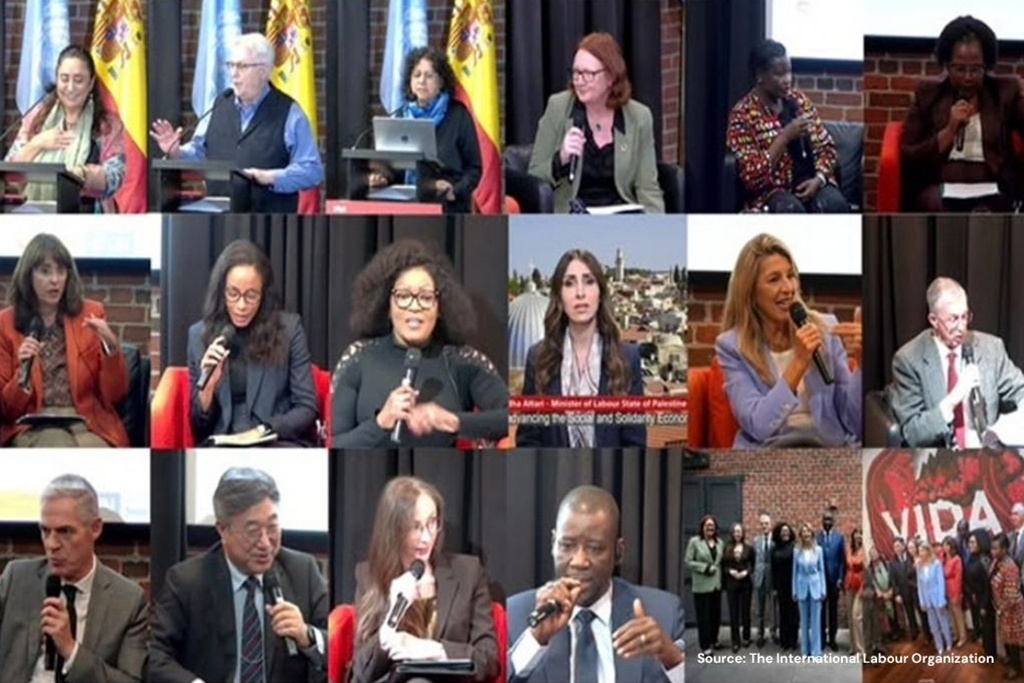
The remarks were delivered at a high-level event co-organized by the UNTFSSE and the Ministry of Labour and Social Economy of Spain (Ministerio de Trabajo y Economía Social) on the sidelines of the United Nations General Assembly High-level Week.
The report highlights continued progress across a wide range of areas, including legal, policy, and institutional frameworks; financial and non-financial support; the integration of the SSE into national and sectoral strategies; statistical development; and stronger cooperation among Member States and across the multilateral system.
At the same time, the report identifies areas where further progress is needed. These include strengthening the evidence base on results, more systematically integrating the SSE into United Nations planning and programming, and continuing efforts on statistics, financing, and international cooperation.
Through the UNTFSSE, UN entities and partners are continuing to strengthen coordination and joint action. The International Labour Organization (ILO), which chairs the Task Force, contributes its longstanding normative, tripartite, policy, statistical, and development cooperation experience on cooperatives and the broader Social and Solidarity Economy to this collective effort.
With 2030 approaching, the report points to two complementary priorities: accelerating progress towards the Sustainable Development Goals (SDGs) while ensuring that the Social and Solidarity Economy is duly considered in preparations for the post-2030 development agenda.
The interventions that followed further highlighted ongoing efforts to strengthen global cooperation around the SSE.
Michael Peck of 1worker1vote and ASETT recapped recent, ongoing, and upcoming events, initiatives, and tools developed by ASETT and its partners to build global bridges for the SSE.
Sandra Moreno Cadena, Executive Secretary of RIPESS—the Intercontinental Network for the Promotion of Social Solidarity Economy—called on Member States and financial institutions to translate recognition of the SSE into practical tools and financing that reach women, young people, informal workers, small producers, and marginalized communities.
The Ministerial Dialogue, titled “Building Social Justice through the SSE in a Fragmented World,” brought together ministers and high-level government representatives from Brazil, Bulgaria, Cabo Verde, France, Guinea-Bissau, Kenya, Poland, the Republic of Korea, the Republic of the Congo, Senegal, Spain, and the State of Palestine.
The participants discussed priorities for strengthening international cooperation on the SSE, including possible elements of a third United Nations General Assembly resolution on the SSE.
They also explored ways to deepen policy exchange and collaboration among Member States, including through the Group of Friends on the SSE.
The discussions underscored the continued importance of coordinated international action to advance the Social and Solidarity Economy and strengthen its contribution to sustainable development, social justice, and the implementation of the global development agenda.
More information and perspectives on this subject
Issues such as the lack of social protection in informal majority economies;
A message for the launch event of Citizen Action for the Normalization of Seoul City Government
Decoding the Differences Between Social and Solidarity Economy (Sse), Social Entrepreneurship, and Related Initiatives