Stepping 2025 with UN Resolution on SSE. Is your country ready?
Issues such as the lack of social protection in informal majority economies;
**By Kon Onn Sein (ASEC Chair)
**
The ASEAN People’s Forum (APF) has emerged as one of Southeast Asia’s leading civil society platforms for advancing human rights, environmental justice, and people-centred regional governance. Held alongside the official processes of the Association of Southeast Asian Nations (ASEAN), it brings together grassroots organisations, Indigenous Peoples, migrant workers, youth, environmental defenders, and human rights advocates to raise concerns and formulate policy recommendations for regional leaders.
Although APF has no formal decision-making authority within ASEAN, it influences regional policy through advocacy, dialogue, and engagement with ASEAN institutions.
**ASEAN Governance and the Role of APF
**
ASEAN promotes political cooperation, economic integration, and regional stability. Initiatives such as the ASEAN Community Vision 2045 reflect ambitions for sustainable development, resilience, and social inclusion. However, its consensus-based decision-making and principle of non-interference have constrained collective responses to human rights violations, environmental degradation, and democratic crises. This underscores the importance of independent civil society participation in regional governance.
Convened annually alongside the ASEAN Summit, APF provides an independent platform for communities to address inequality, displacement, environmental destruction, and shrinking civic space. It also strengthens regional solidarity by connecting organisations across countries to coordinate responses to shared challenges, including the Myanmar conflict, transboundary haze, migrant worker protection, and digital repression.
**Influencing Regional Policy
**
APF advances its advocacy through the Joint Civil Society Statement, developed through national and regional consultations and presenting recommendations on human rights, environmental protection, labour rights, and social justice to ASEAN leaders and the Secretariat.
The ASEAN Leaders’ Interface also provides an opportunity for elected civil society representatives to engage directly with regional leaders. Beyond the summit, civil society organisations engage with ASEAN bodies, including the ASEAN Intergovernmental Commission on Human Rights (AICHR), the ASEAN Commission on the Promotion and Protection of the Rights of Women and Children (ACWC), and the ASEAN Committee on Migrant Workers (ACMW).
When institutional channels prove insufficient, APF amplifies its advocacy through public campaigns, international media, and cross-border solidarity networks.
**Human Rights, Environmental Justice, and Alternative Regionalism
**
APF recognises the close relationship between human rights and environmental justice. Discussions address enforced disappearances, arbitrary detention, attacks on environmental defenders, loss of livelihoods, and restrictions on civic space, with particular concern over Myanmar and West Papua.
Environmental justice is understood not merely as conservation but as the protection of community rights, livelihoods, land, and natural resources. APF challenges economic models that prioritise unlimited profit while shifting environmental and social costs onto vulnerable communities. It advocates climate justice, decent work, digital rights, and stronger protection for affected communities.
Rather than rejecting ASEAN, APF promotes alternative regionalism that places human dignity, environmental sustainability, and social justice at the centre of regional cooperation. Within this vision, the Social and Solidarity Economy (SSE) offers a practical pathway to reduce inequality, strengthen community resilience, and scale up community-led economic solutions across Southeast Asia.
**Challenges and the Way Forward
**
APF’s relationship with ASEAN remains constructive but contested. Efforts by some governments to replace independent civil society representatives with state-approved delegates have occasionally triggered disputes and walkouts during the ASEAN Leaders’ Interface.
Despite these challenges, APF continues to build cross-sector coalitions involving policymakers, businesses, academics, youth, and international partners to advance more inclusive regional cooperation.
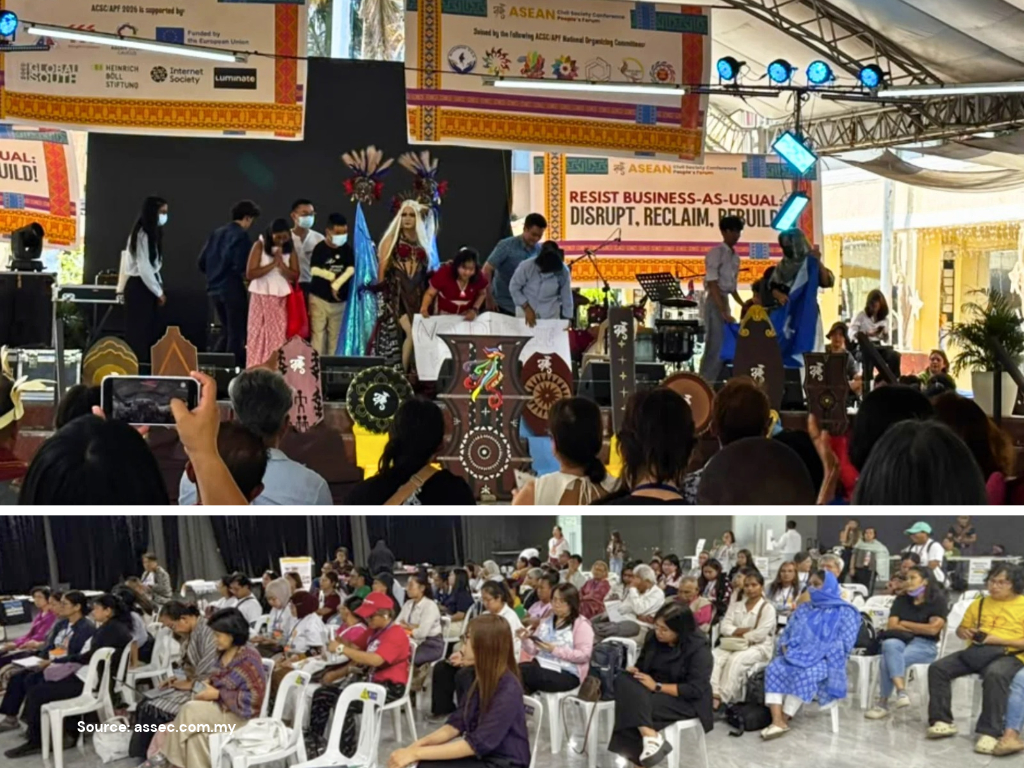
The 2026 APF in Manila delivers a clear message: Southeast Asia cannot continue with business-as-usual approaches while inequality, human rights violations, environmental destruction, and shrinking democratic space persist.
Its call to civil society is to resist systems that concentrate wealth and political power, disrupt structures that perpetuate injustice, reclaim people's rights and democratic space, and rebuild a region founded on solidarity, human dignity, environmental sustainability, and meaningful democratic participation.
Ultimately, APF 2026 seeks to move advocacy beyond addressing individual violations towards challenging the economic and political structures that allow injustice to persist. In this context, SSE represents an alternative development pathway that places people, solidarity, and collective well-being at the heart of regional transformation.
More information and perspectives on this subject
Issues such as the lack of social protection in informal majority economies;
A message for the launch event of Citizen Action for the Normalization of Seoul City Government
Decoding the Differences Between Social and Solidarity Economy (Sse), Social Entrepreneurship, and Related Initiatives